

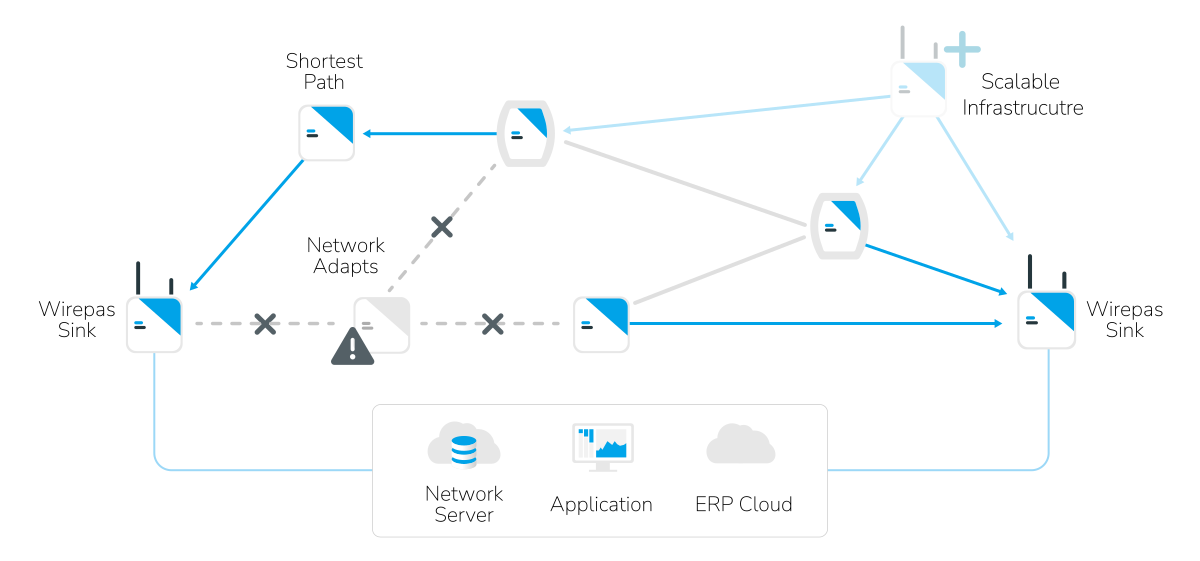
Wirepas is a fully decentralized mesh networking technology built for massive-scale, low-power IoT deployments. Unlike traditional star-topology networks, Wirepas devices communicate directly with one another, autonomously routing data hop-by-hop through the mesh until it reaches a sink node connected to the network server. This de-centralized architecture removes any single point of failure and lets networks scale to millions of devices without added infrastructure. Operating in sub-GHz and 2.4 GHz bands, Wirepas supports flexible mesh, tree, and star topologies, making it ideal for dense industrial environments, smart buildings, asset tracking, and logistics, where reliability and self-healing connectivity matter most.
Wirepas Technology Explained
Mesh networking redefined for massive scale.
Wirepas Range
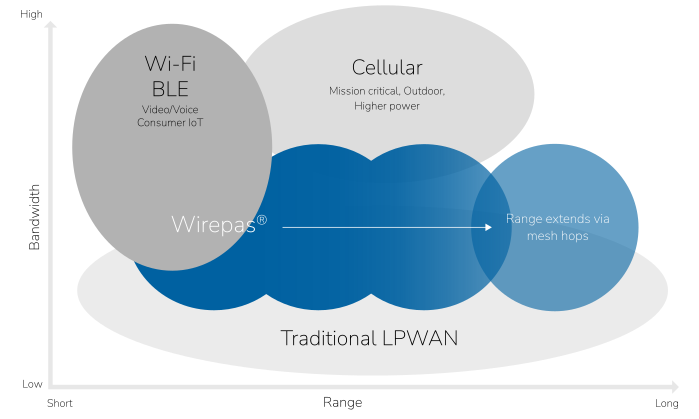
Wirepas doesn't rely on a single long-distance radio link — it achieves range through its mesh architecture, where every device extends the network by relaying data to its neighbors. A single hop typically covers tens to a few hundred meters depending on frequency band and environment, but because each node can act as a repeater, the effective coverage of a Wirepas network is virtually unlimited: adding more devices extends reach without adding gateways. This hop-by-hop design also lets Wirepas trade range for bandwidth on demand, using lower data rates to push signals further per hop, or higher data rates when throughput matters more than distance. The result is a self-healing network that automatically re-routes around obstacles or failed nodes, delivering reliable coverage across large industrial facilities, warehouses, and multi-building campuses where a single radio link could never reach every device.
Key Benefits of Wirepas Technology
Wirepas is a leading mesh networking protocol for large-scale IoT deployments, offering massive scalability, self-healing reliability, and low power consumption. These features make Wirepas ideal for diverse use cases, from smart buildings to industrial asset tracking.
Massive Scalability
Wirepas networks can scale to millions of devices within a single deployment, since every device also acts as a router for its neighbors. There's no dependency on centralized infrastructure, so dense networks can grow across large industrial sites, warehouses, and multi-building campuses simply by adding more nodes.
Low Power Consumption
Wirepas devices are optimized for low power consumption, enabling years of operation on small batteries, even while relaying data for neighboring nodes. This makes it ideal for long-term, maintenance-free IoT applications such as asset tracking and industrial sensing.
Cost-Effective Deployment
Because Wirepas devices extend coverage by relaying data through one another, networks need far fewer gateways than traditional star-topology systems. This lowers installation and infrastructure costs, making Wirepas an economical choice for large-scale, high-density IoT deployments.